
Navigating Labuan Bajo Green Season for an Exclusive Sailing Experience
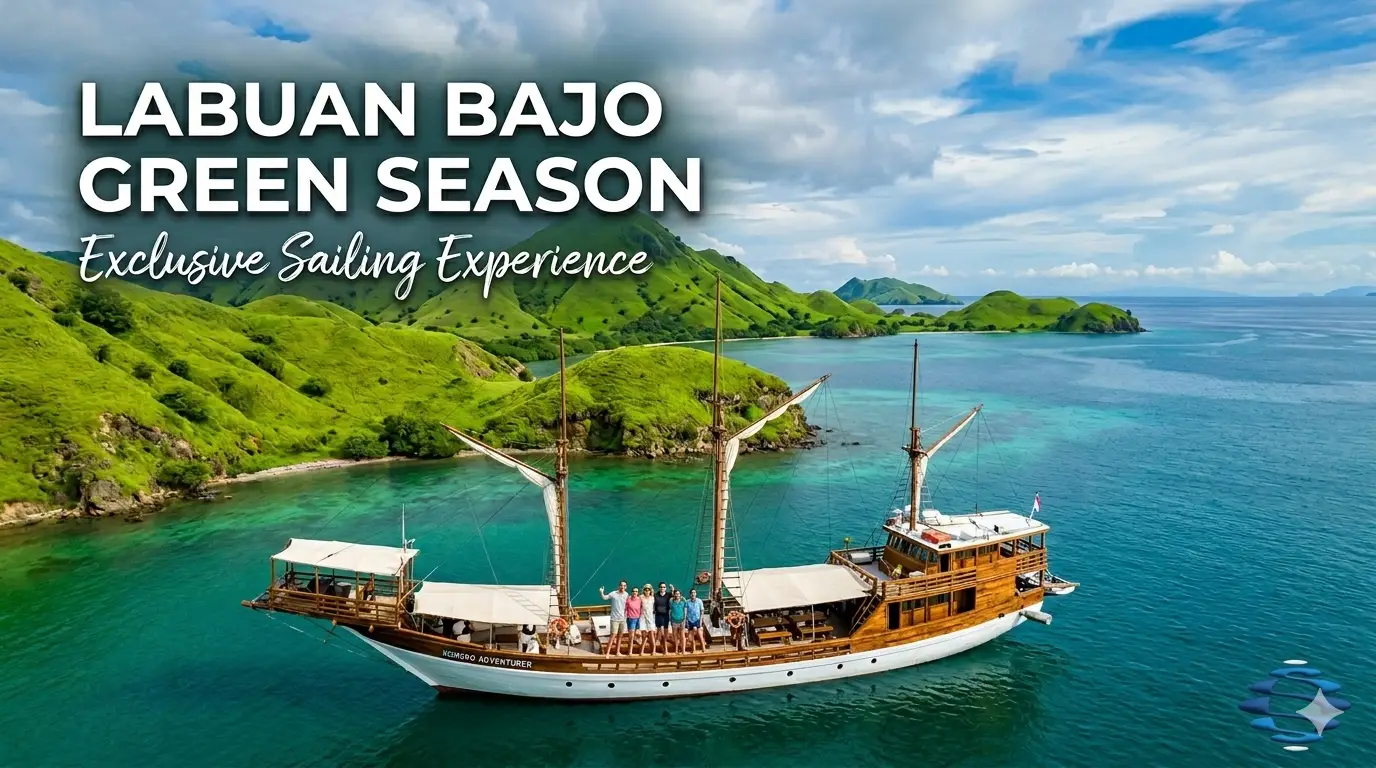
When travelers ask me about the best time to explore the Komodo National Park, many expect me to say July or August. However, for those seeking the true soul of the archipelago, I always point toward the months between December and March. We call this the Green Season. It is a period of ecological rebirth that transforms our rugged, dusty islands into a lush, emerald paradise that feels more like a scene from a prehistoric world than a typical tropical getaway.
The Dramatic Transformation of the Flores Landscape
As a guide who monitors these lands daily, I find the visual shift during the Green Season to be nothing short of miraculous. During the dry months, islands like Padar and Rinca are dominated by a harsh, Savannah-like brown. But as soon as the West Monsoon brings the first rains in November, the dormant seeds in the soil awaken.
By January, the entire topography is covered in a deep emerald green. The air is noticeably crisper and cleaner, stripped of the haze and dust of the dry season. For photographers, this is the ultimate time to visit. The soft cloud cover acts as a natural lightbox, creating perfect saturation for the turquoise waters against the vibrant green hills without the harsh shadows of the midday sun.
Understanding the Climate and Daily Dynamics
It is a common misconception that the Green Season means constant rain. In reality, the weather remains dynamically tropical. Data shows that even in the heart of the season, temperatures stay comfortable between $24^{\circ}C$ and $31^{\circ}C$. Rainfall usually comes in short, heavy tropical bursts, often in the late afternoon or overnight, leaving wide windows of sunshine during the day for trekking and snorkeling.
Parameter | Dry Season (April - Oct) | Green Season (Nov - March) | Transition (April & Nov) |
|---|---|---|---|
Max Temperature | $30^{\circ}C - 33^{\circ}C$ | $31^{\circ}C$ | $32^{\circ}C$ |
Rainfall Frequency | 1-4 days/month | 12-18 days/month | 5-9 days/month |
Landscape Condition | Brown / Dry Savannah | Emerald Green / Lush | Brown-Green Gradient |
Dominant Wind | Strong Southeast | Variable Northwest | Light / Unpredictable |
The atmosphere after a rain shower offers an extraordinary clarity that you simply cannot find in the dusty months of August. It is the best time for those who appreciate the freshness of the tropics.
The Secret Season for Manta Ray Encounters
While many people worry about sea conditions, the Green Season is actually the peak time for one of our most sought-after residents: the Manta Ray. From December to February, the currents bring nutrient-rich water into the central and southern parts of the park. This plankton boom creates a feeding frenzy at sites like Manta Alley and Karang Makassar.
While underwater visibility might be slightly lower due to the abundance of plankton, the sheer density of marine life is at its peak. It is common to see dozens of Mantas dancing in the current. As professional guides, we shift our focus to the southern sites like Cannibal Rock and the Yellow Wall, where the soft corals and invertebrates show their most vivid colors in the cooler, nutrient-dense water.
Protected Snorkeling Sites for a Smooth Journey
Safety and comfort are my top priorities when I captain a trip. During the Green Season, we use the geography of the islands to our advantage. While the north might experience some waves from the northwest winds, the southern bays remain calm and crystal clear.
Siaba Besar: A sheltered bay that remains calm even when it is windy elsewhere. It is a stable habitat for sea turtles all year round.
Pulau Kelor: Its natural bay provides a safe anchorage for our Phinisi and perfect conditions for beginner snorkelers.
Pink Beach (Central): The high hills behind the beach act as a natural windbreak, keeping the waters peaceful for swimming.
Pulau Kanawa: Located closer to Labuan Bajo, it offers shallow reef exploration that is relatively safe from large swells.
Why Savvy Travelers Choose the Green Season
The most significant luxury of the Green Season is privacy. In the peak of July, the summit of Padar Island can be crowded with hundreds of visitors. During the Green Season, you might find yourself as the only group on the entire beach. This "private island" feeling is what high-end international travelers are increasingly looking for.
Furthermore, there is a clear economic and service advantage. Many luxury Phinisi charters and high-end resorts offer "Green Season" rates, which can be 30% to 50% lower than peak season prices. Because there are fewer boats on the water, our crew can provide a much more personalized level of service, curating every meal and excursion to your specific interests.
Beyond the Sea: Exploring the Interior of Flores
When the sea gets a bit too adventurous, I take my guests into the heart of Flores. The interior of the island is at its most spectacular during this season.
Wae Rebo: The famous traditional village feels truly mystical when the low clouds of the Green Season settle between the Mbaru Niang houses.
Cunca Wulang Waterfall: The water volume is at its peak, and the surrounding jungle is incredibly lush, offering a refreshing "forest bathing" experience.
Cultural Immersion: This is a great time for indoor activities like traditional Manggarai cooking classes or visiting the limestone caves like Gua Rangko, where the blue saltwater pool remains calm and sheltered regardless of the weather outside.
Maritime Safety and Professional Standards
Sailing in the Green Season requires experience and the right technology. Our modern Phinisi vessels, built from ironwood and teak, are designed for these waters. We utilize real-time AIS (Automatic Identification System) and weather radar to monitor sea conditions.
As a professional guide, I have the authority to adjust itineraries on the fly. If one area looks a bit rough, I know three other hidden bays that will be perfectly calm. We ensure that every guest is equipped with international standard life jackets (SOLAS), and we always have medical oxygen and reliable VHF radio communication on board.
Preparing for Your Green Season Adventure
To make the most of your trip, I recommend bringing the following:
Polarizer Filters: Essential for cutting through the water's reflection and making those green hills pop in your photos.
Quality Dry Bags: A minimum of IPX6 rating to keep your electronics safe during boat transfers.
Rain Sleeves: For your camera equipment so you can capture the beauty of a tropical downpour safely.
Silica Gel: To manage humidity and protect your lenses in the tropical environment.
The Labuan Bajo Green Season is not a "second-best" option; it is a premium, exclusive window into the most vibrant version of the Komodo National Park. If you value peace, nature in its most lush state, and world-class marine encounters without the crowds, this is the time to sail with us.