
Guide to the Labuan Bajo Manta Ray Season with The Seven Seas Group
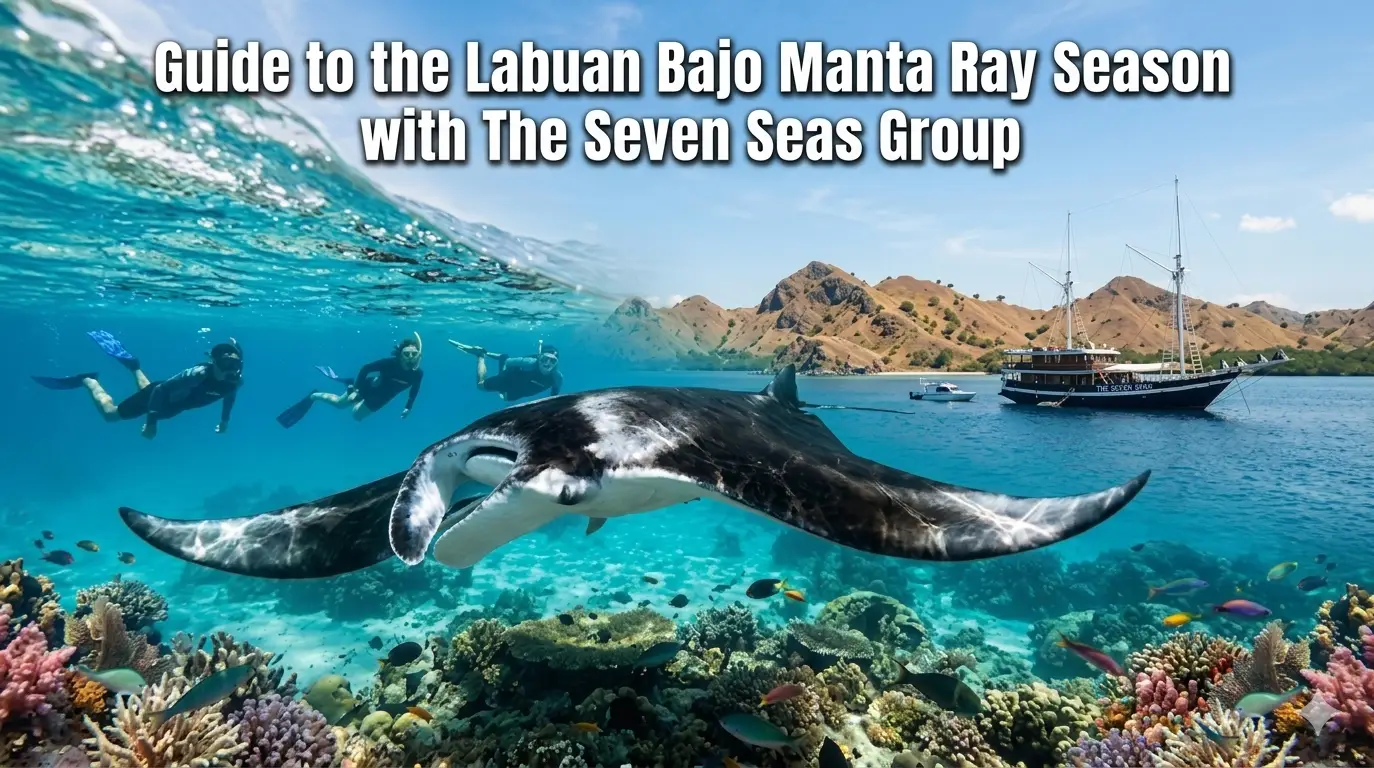
As a local guide born and raised on the rugged shores of West Manggarai, Flores, I have spent my entire life watching the tides of the Flores Sea clash with the Indian Ocean. Today, I have the absolute privilege of working with The Seven Seas Group, welcoming adventurous souls from around the world aboard our traditional wooden liveaboard. When travelers step onto our deck, their eyes are almost always filled with the same dream, which is to glide face to face with the legendary manta rays of Komodo National Park.
Our beautiful archipelago is one of the very few places on Earth where these intelligent giants can be seen all year round. However, the secret to a truly magical encounter lies in understanding the complex rhythm of our waters. The movements of the rays are dictated by shifting winds, underwater temperatures, and the seasonal highway of food known as the Indonesian Throughflow. If you are planning an expedition to dive or snorkel with these magnificent creatures, this insider guide will help you choose the perfect window for your journey.
Understanding the Clash of Two Oceans
To truly appreciate the Labuan Bajo manta ray season, you must first understand the unique geography of our home. Komodo National Park sits directly at the boundary of two vastly different marine environments. To our north lies the warm Pacific Ocean, while to our south rests the deep, cold Indian Ocean.
The Indonesian Throughflow acts as a giant marine funnel, forcing massive volumes of water through the narrow channels between our islands. This constant movement of water creates powerful tidal currents and nutrient-rich upwellings. When these currents hit our shallow reefs, they carry up millions of tiny organisms, creating a massive buffet of plankton that draws reef mantas, Mobula alfredi, and giant oceanic mantas, Mobula birostris, to the surface.
Our year is split into two main seasons, the dry season and the wet season, and each season brings a completely different movement pattern for our local manta populations.
The Dry Season (April to October)
During these months, dry winds blow from the Australian continent, bringing clear blue skies and beautifully calm surface conditions. In the southern parts of the park, cold upwellings bring nutrient-rich waters from the deep Indian Ocean. This drop in temperature, sometimes down to 22 degrees Celsius, draws incredible numbers of manta rays to feed and clean at our southern sites. Meanwhile, the northern and central parts of the park remain warm and clear, offering excellent visibility for divers.
The Wet Season (November to March)
As the Northwest Monsoon arrives, it brings warmer air, occasional afternoon tropical showers, and a reversal of our ocean currents. During this period, the plankton blooms shift into the central and northern sectors of the park. Because of this shift, massive aggregations of manta rays gather at our shallow central cleaning stations. While the weather can be more humid and the seas slightly more variable, this is widely considered the absolute peak manta ray season for our shallow reef sites.
Season | Best Months | Average Water Temperature | Underwater Visibility | Primary Manta Locations |
|---|---|---|---|---|
Dry Season | April to October | 25 to 29°C in North; 22 to 25°C in South | 20 to 35 meters | Southern sites like Manta Alley and central channels |
Wet Season | November to March | 27 to 30°C across most sites | 10 to 20 meters | Central sites like Karang Makassar and Mawan |
Shoulder Sweet Spots | May and November | 25 to 28°C | 25 to 30+ meters | Both Central and Southern sites active |
The Best Manta Sites in Komodo National Park
Over my years of guiding with The Seven Seas Group, I have learned that every dive site in Komodo has its own unique personality and set of challenges. When we sail, we carefully analyze the daily tides to ensure we arrive at these legendary sites at the exact moment the mantas are most active.
Karang Makassar (Manta Point)
Located in the central section of the national park, Karang Makassar is the most famous manta site in our country. This is a massive, shallow reef plateau stretching nearly three kilometers long. The bottom is mostly made of coral rubble and sand, sitting at a shallow depth of only 5 to 18 meters.
Because it is so shallow, Karang Makassar is an incredible spot for both certified scuba divers and snorkelers. The site serves as a giant cleaning station where small cleaner wrasses live in the coral bommies. The mantas will hover nearly motionless over these stations, letting the tiny fish clean parasites from their skin.
To dive here, we perform a positive entry from our speedboats and let the gentle drift current carry us along the plateau. It is not uncommon to see ten, twenty, or even more mantas gliding alongside us on a single drift.
Manta Alley
Tucked away in the far south of Komodo Island, Manta Alley is a wild, high-energy channel that feels like a forgotten world. This site is fully exposed to the open ocean, meaning it experiences strong currents, surge, and cold, nutrient-rich water.
This is an advanced dive site that requires excellent buoyancy control and experience in heavy currents. However, the rewards are spectacular. Manta Alley features narrow rocky channels and steep coral slopes where we frequently encounter huge schools of fish, reef sharks, and dozens of feeding manta rays.
This is also the best place in the park to spot the massive, mysterious giant oceanic manta rays. Because of the cold water here, we always make sure our guests are equipped with thicker 5mm or 7mm wetsuits and hoods before they jump in.
Mawan
Mawan is a beautiful, sheltered island in the central park that offers a much more intimate alternative to the larger drift sites. The currents here are generally milder, making it an excellent spot for newer divers and family snorkel trips.
The cleaning station at Mawan sits on a shallow reef slope surrounded by exceptionally clear water. The manta rays here are incredibly curious, often gliding within inches of divers who remain still on the sandy bottom. It is a photographer's dream, allowing you to capture stunning, natural-light shots of these gentle giants against the pristine coral gardens.
Dive Site | Depth Range | Typical Current | Best Level | Primary Season |
|---|---|---|---|---|
Karang Makassar | 5 to 18 meters | Mild to Medium | Open Water and Snorkelers | September to April |
Manta Alley | 5 to 30 meters | Strong and Unpredictable | Advanced Open Water Only | October to May |
Mawan | 5 to 18 meters | Mild to Moderate | Open Water and Snorkelers | Year-round |
Ancient Folklore and the Spirits of the Sea
Long before Labuan Bajo became a premium travel destination, our ancestors held a deep, spiritual connection to the ocean and its inhabitants. The traditional inhabitants of these islands, including the nomadic Suku Bajau sea gypsies, the Bugis, and the native Ata Modo people, have shared these waters with the manta rays for centuries.
In our local folklore, the manta rays are regarded as sacred guardians of the sea. Our elders traditionally believed that manta rays carry the souls of those lost at sea, guiding them safely to the afterlife. Because of this belief, a strict cultural taboo was established against harming or hunting them.
If a manta ray approached a fisherman's canoe near the shore, it was seen as a powerful message or a blessing from the ancestors. This deep respect created a natural, community-led conservation system that protected these vulnerable animals long before modern laws were put in place.
Today, when I guide travelers into the water, I always ask them to remember this local heritage. When you look into the eye of a manta ray, you are not just looking at a fish, you are connecting with a creature that has been revered as an ocean spirit by my people for generations.
Professional Code of Conduct for Manta Diving
As professional guides with The Seven Seas Group, our number one priority is to ensure your safety while protecting the fragile marine environment. Manta rays are incredibly intelligent animals with the largest brain-to-body ratio of any fish, and they will willingly interact with us if we respect their space.
However, bad behavior can easily scare them away and permanently damage their cleaning stations. To keep our encounters safe and respectful, we ask all our guests to follow our strict code of conduct.
Stay Low and Downcurrent
When we arrive at a cleaning station, we never swim directly over the top of the coral bommie. Instead, we position ourselves low on the surrounding sand or rubble, keeping downcurrent of the station. This leaves the overhead space clear, allowing the mantas to glide in comfortably from the deep blue.
Never Chase or Touch
It can be tempting to swim after a manta, but chasing them will only cause them to flee immediately. Their skin is also covered in a delicate, protective mucus layer that shields them from infections. Touching them damages this barrier, exposing them to harmful bacteria. The best encounters happen when you remain completely still and let their natural curiosity bring them to you.
Master Your Buoyancy
Maintaining perfect neutral buoyancy is essential when diving around our shallow reefs. Accidentally crashing into the reef can destroy centuries of coral growth, while kicking up sand with your fins will disturb the cleaning fish and ruin the underwater visibility for everyone.
Dive in Small, Supervised Groups
Large crowds of chaotic divers can easily stress the marine life. At The Seven Seas, we keep our dive groups small and highly supervised, with experienced guides leading every single excursion to manage the currents and ensure a peaceful, private interaction.
Citizen Science and the MantaMatcher Project
One of the most exciting aspects of modern diving in Labuan Bajo is the opportunity for our guests to play a direct role in ocean conservation. Through our close partnership with marine researchers, we encourage our travelers to become citizen scientists during their holiday.
Every manta ray has a completely unique pattern of black spots on its white belly. This pattern acts exactly like a human fingerprint, allowing us to identify and track individual rays over their entire lifespan, which can last up to 40 years.
During our dives, if you manage to capture a clear photograph or video of a manta's belly, we will help you submit it to MantaMatcher.org, a global database run by the Marine Megafauna Foundation. The database uses advanced facial-recognition algorithms to scan the spots and match your photo with previously identified mantas.
If your manta is already in the system, you will receive an email update telling you its name, where it has traveled, and when it was last seen. If you capture a completely new manta, you will get the incredible honor of naming it yourself, leaving a lasting legacy in the scientific protection of our oceans.
Why Experience Komodo with The Seven Seas Group
While there are many day boats departing from the mainland of Labuan Bajo, exploring this vast UNESCO World Heritage Site on a dedicated luxury liveaboard is a completely different experience. The Seven Seas is a magnificent 40-meter Buginese schooner, traditionally handcrafted from solid teak and ironwood by master shipbuilders.
We have custom-designed our vessel to offer the ultimate combination of traditional charm and modern luxury. With eight spacious, air-conditioned cabins, en-suite bathrooms, and beautiful outdoor lounge areas, the ship serves as your private floating sanctuary in the wild. We also carry sea kayaks, stand-up paddleboards, and three custom speedboats to ensure you have unparalleled access to every hidden cove, deserted beach, and dive site.
But what truly sets us apart is our incredible crew and our philosophy of exploration. We do not believe in rigid, pre-set itineraries. If a cruise operator tells you exactly where you will dive next Tuesday, they are not practicing safe or smart diving in Komodo.
Our experienced cruise directors, such as Mark, Karl, Linda, and Angel, study the winds and tides in real time. If we see that a site has too much current or is crowded with other vessels, we simply adjust our sails and take you to a quiet, pristine alternative where we can have the ocean entirely to ourselves.
Our journeys are also designed to give you a complete, balanced experience of our home. In between world-class dives with manta rays, we will take you on early morning treks to see the legendary Komodo dragons wandering the golden savannah, organize private beach barbecues under a canopy of stars, and sail through migratory corridors where we frequently spot dolphins, pilot whales, and blue whales.
Preparing for Your Epic Maritime Adventure
If you are ready to turn your dream of swimming with manta rays into reality, the gates of Labuan Bajo are open and waiting for you. Direct flights from Bali and other major cities bring you straight to Komodo International Airport, where our warm team will meet you and transfer you directly to our vessel.
I always advise our guests to arrive a day early if possible, giving themselves time to adjust to our warm tropical climate, stay hydrated, and ensure they are fully rested before we set sail into the currents. Whether you are a seasoned advanced diver ready to tackle the wild channels of Manta Alley, or a snorkeling family looking to float over the shallow sands of Karang Makassar, we at The Seven Seas Group are ready to show you the absolute best of our marine paradise. Pack your camera, bring your sense of wonder, and let the magic of the manta ray season unfold before you.