
The Legendary Indigenous Divers of Labuan Bajo
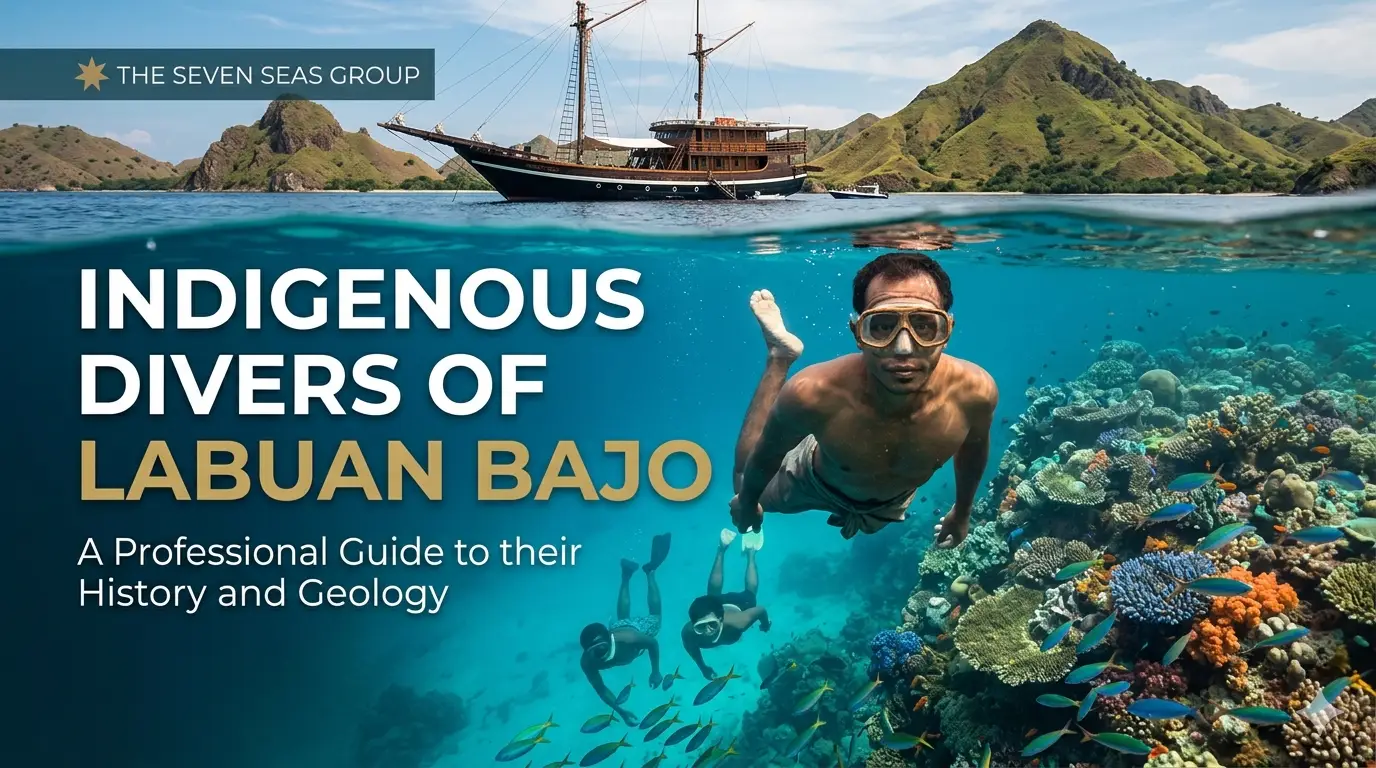
The name Labuan Bajo serves as an enduring monument to the maritime heritage of Flores, translating directly from the local tongue as the "Harbor of the Bajo". For centuries, the indigenous divers of the Bajo tribe, widely known as the Sea Nomads or Orang Laut, have maintained an unbroken relationship with the hyper-diverse waters of the Komodo National Park. As the professional guiding team of the Seven Seas Group, drawing upon over forty years of local navigation and partnership with these coastal communities, the local experts provide an unparalleled perspective on how this unique culture has adapted to one of the most hydrodynamically complex marine environments on Earth. Sailing aboard the Seven Seas, a traditional 40-meter Buginese ironwood schooner built by master craftsmen from Sulawesi under the pioneering vision of Mark Heighes and Jos Pet, travelers are invited to explore the intersection of geological history, human evolution, and deep-seated marine spiritualism.
Geological Evolution and the Marine Environment of Flores
The islands comprising the Lesser Sunda Arc, including Komodo, Rinca, and Padar, were forged millions of years ago by intense volcanic activity along the Pacific Ring of Fire. This dramatic landscape was sculpted by the ongoing collision of the Indo-Australian and Eurasian tectonic plates, forcing magma upward to form jagged ridges, steep cliffs, and deep marine basins. The dry volcanic soil of these islands supports a unique savannah ecosystem, while the underwater topography features dramatic drop-offs, submerged pinnacles, and intricate coral reefs.
The key to the region's extraordinary marine biodiversity lies in the Indonesian Throughflow, the largest movement of oceanic water on earth. Driven by a significant sea level height difference between the Pacific and Indian Oceans, this colossal current system acts as a hydraulic conveyor belt, pushing up to 15 Sverdrups of warm, low-salinity Pacific water southward through the narrow channels of the Lesser Sunda Islands. When this massive body of water collides with the rugged underwater topography of the Komodo archipelago, it triggers localized upwellings. These upwellings draw cold, nutrient-rich water from the deep ocean to the sunlit surface, fertilizing the shallow reefs and supporting a complex food web that includes over 1,000 fish species, 260 coral species, and marine megafauna such as manta rays, sharks, and whales.
Dive Site | Topographical Features | Current Dynamics | Primary Marine Sightings |
Batu Bolong | Submerged volcanic rock pinnacle with deep vertical walls | Intense, unpredictable currents often called Current City | Swirling schools of reef fish, reef sharks, and macro life |
Castle Rock | Submerged seamount located in the northern reaches of the park | Fierce, high-velocity drift currents requiring streamlined buoyancy | Gray reef sharks, giant trevallies, barracudas, and schooling jacks |
Crystal Rock | Exposed rock pinnacle with excellent underwater visibility | Strong tidal flows with sudden upcurrents and downcurrents | Vibrant soft corals, pygmy seahorses, and cruising pelagic predators |
Manta Alley | Deep southern rocky channels with cooler water temperatures | Moderate to strong nutrient-rich upwelling currents | Feeding and cleaning aggregations of giant reef manta rays |
History and Settlement Trajectory of the Bajo Tribe
The historical narrative of the Bajo people is intimately tied to a life of movement. Anthropological records indicate that the tribe originated from the Sulu Archipelago in the southern Philippines before migrating across the vast archipelagos of Southeast Asia, eventually settling in the coastal regions of Malaysia, Brunei, and eastern Indonesia. For generations, they lived exclusively aboard traditional wooden houseboats called lepa-lepa, which functioned as their homes, kitchens, and workplaces. They identify themselves as the Sama people, contrasting their maritime identity against land-dwellers, whom they refer to as the Bagai.
This nomadic lifestyle began to shift significantly in the mid-20th century. During the 1950s, and later accelerated by government initiatives in the 1980s, the Bajo were encouraged to transition to permanent coastal settlements to facilitate administrative integration and resource management. Although they abandoned their completely boat-dwelling lifestyle, they did not move inland. Instead, they constructed self-sufficient stilt villages over shallow reefs and atolls, ensuring that their daily lives remained physically anchored to the sea. Despite this transition, their cultural heritage remains an indispensable pillar of Labuan Bajo's identity.
Evolutionary Physiology of Extreme Hypoxia Tolerance
The extraordinary diving capabilities of the Bajo are not merely the result of lifelong training; they represent a rare, genetically documented case of human evolution in response to an aquatic lifestyle. While average humans can hold their breath for only a short period underwater, adult Bajo divers routinely descend to depths of 20 to 30 meters, and occasionally up to 70 meters, for minutes at a time using only simple wooden goggles and hand-crafted spears.
In 2018, a groundbreaking genetic study led by Melissa Ilardo and published in the journal Cell revealed that the Bajo have developed distinct biological adaptations to tolerate extreme hypoxia. Through ultrasound imaging, researchers determined that the Bajo possess spleens that are approximately 50% larger than those of neighboring non-diving populations, such as the Saluan. When a diver submerges, the mammalian dive reflex triggers the spleen to contract, injecting a dense reserve of oxygen-rich red blood cells into the bloodstream and prolonging underwater survival.
Physiological Marker | Land-Dwelling Populations (Bagai) | Indigenous Bajo Divers (Sama) | Evolutionary and Genetic Mechanism |
Spleen Size | Standard baseline volume | Approximately 50% larger organ volume | Regulated by selection on the PDE10A gene, elevating thyroid hormones |
Human Dive Reflex | Standard autonomic response | Highly accelerated and efficient response | Mediated by selection on the BDKRB2 gene, managing peripheral vasoconstriction |
Breath-Hold Capacity | Typically 45 to 90 seconds | Regularly 2 to 5 minutes, up to 13 minutes | Enabled by elevated red blood cell storage and lowered metabolic rate |
Physical Adaptation | No distinct genetic divergence | Biological adaptation to repetitive hypoxia | Natural selection favoring survival traits over millennia of marine foraging |
Spiritual Cosmology, Customs, and Local Conservation Laws
To understand the Bajo is to appreciate the intricate spiritual relationship they maintain with the ocean. Their cosmology is characterized by a unique syncretism of Islamic principles and ancestral animism, centered on the belief in Mbo Ma Dilao, the ancestral Lord of the Sea. The Bajo believe that the ocean is inhabited by invisible spirits that guard marine resources and demand absolute respect. To this day, when a Bajo child is born, the family releases the newborn's placenta into the sea, establishing an eternal bond between the individual and the marine world.
Their interactions with the marine ecosystem are governed by pamali, a system of customary taboos that act as highly effective conservation laws. Under pamali, destructive fishing practices, overharvesting around coral reefs (pasi), and throwing waste into the water are strictly forbidden. Violations are believed to offend the sea spirits, bringing misfortune, illness, or severe storms upon the community. These customs are reinforced by the ethical philosophies of tahang diri, meaning self-control, and ngatonang diri, meaning self-awareness, which demand that individuals fish with care, avoid greed, and maintain harmony with both the natural environment and the spiritual world.
This deep respect for heritage aligns with the broader cultural landscape of Flores and West Manggarai. For instance, the Formulamoso tradition governs the division of customary land using a unique finger formula, requiring individuals from other tribes to present a rooster and local moke wine to the village elders. Similarly, the Kepok tradition welcomes esteemed guests to the region with a traditional ceremony featuring a red rooster and white moke, illustrating the profound hospitality and ancestral pride that define the communities of Labuan Bajo.
Cultural Concept | Core Definition and Practice | Role in Marine and Social Governance |
Mbo Ma Dilao | The ancestral spirit and spiritual Lord of the Sea | Directs fishermen to perform rituals before sailing to seek protection |
Pamali | Customary taboos restricting specific behaviors at sea | Prevents habitat destruction by forbidding waste disposal and overfishing |
Tahang Diri | The ethical practice of maintaining strict self-control | Discourages greed, promoting selective and sustainable harvesting |
Ngatonang diri | The practice of conscious self-awareness | Encourages humility, mutual trust, and peaceful conflict resolution |
Kepok Ceremony | Traditional welcoming ritual using a red rooster and moke | Demonstrates hospitality and respect for ancestral social ties |
Mesa Island as a Living Cultural Landmark
For travelers wishing to observe these traditions firsthand, Mesa Island, located near the boundaries of the Komodo National Park, serves as an essential cultural destination. Unlike typical tourist spots, Mesa Island is a bustling, self-sufficient fishing village inhabited almost exclusively by people of Bajo descent.
Walking through the village of stilt houses, which are elevated above shallow turquoise waters and connected by small wooden bridges, visitors can observe how the community coexists in harmony with the sea. The islanders' daily lives are governed by the tides rather than modern schedules. Residents can be seen crafting intricate fishing nets, drying salted fish under the sun, and building traditional wooden boats. Mesa Island also functions as a living example of ecological sustainability. Because their livelihood depends entirely on the health of the surrounding reefs, the fishermen practice selective harvesting, utilizing hand-made spears, nets, and traps designed to minimize ecological impact and preserve the marine sanctuary for future generations.
Local Guiding Expertise and Sustainable Liveaboard Expeditions
Sailing the highly dynamic passages of the Flores Sea requires specialized maritime knowledge and strict adherence to safety protocols. This is where the expertise of local guiding teams and pioneering operators becomes indispensable. The Bajo Dive Club, established in 1991 as the first diving club in Labuan Bajo, has spent decades documenting these waterways, training local guides, and setting high standards for personalized, safe exploration.
Similarly, the Seven Seas Group, operating a premier luxury liveaboard, utilizes a highly trained Indonesian crew and experienced cruise directors who have spent decades navigating the Komodo archipelago. Because tide heights and current directions can shift rapidly, planning dives using precise tide tables is crucial to ensuring that divers experience sites like Castle Rock or Batu Bolong at the optimal time. A liveaboard expedition remains the definitive way to explore the full spectrum of Komodo's dive sites, from the pelagic-rich waters of the north to the macro-focused havens of the deep south.
By choosing professional operators that employ local guides, travelers actively support the preservation of the region's cultural and ecological heritage. These efforts are vital to protecting the delicate balance of the marine world, ensuring that the legendary skills of the Bajo divers and the breathtaking biodiversity of the Coral Triangle remain preserved for generations to come.